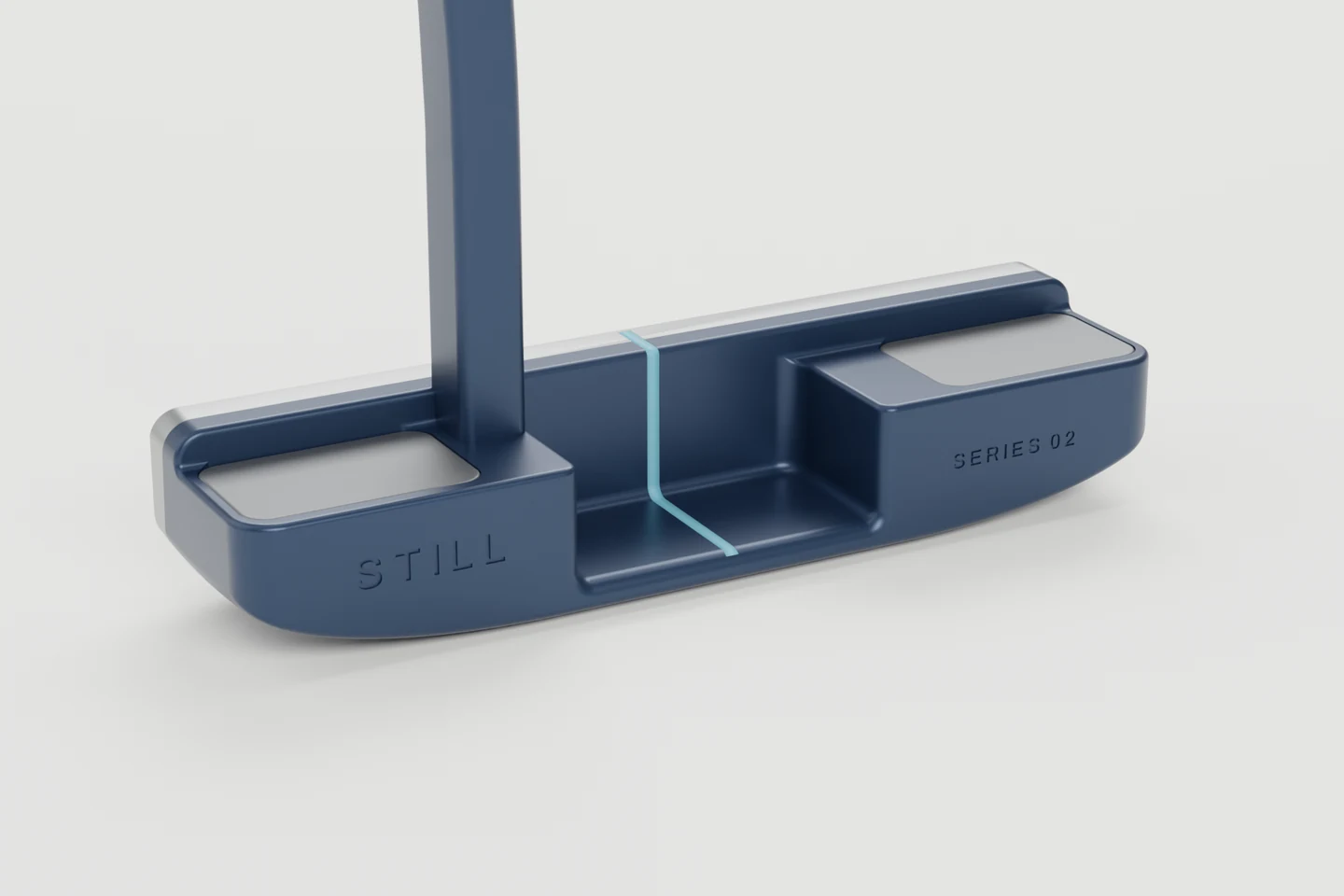
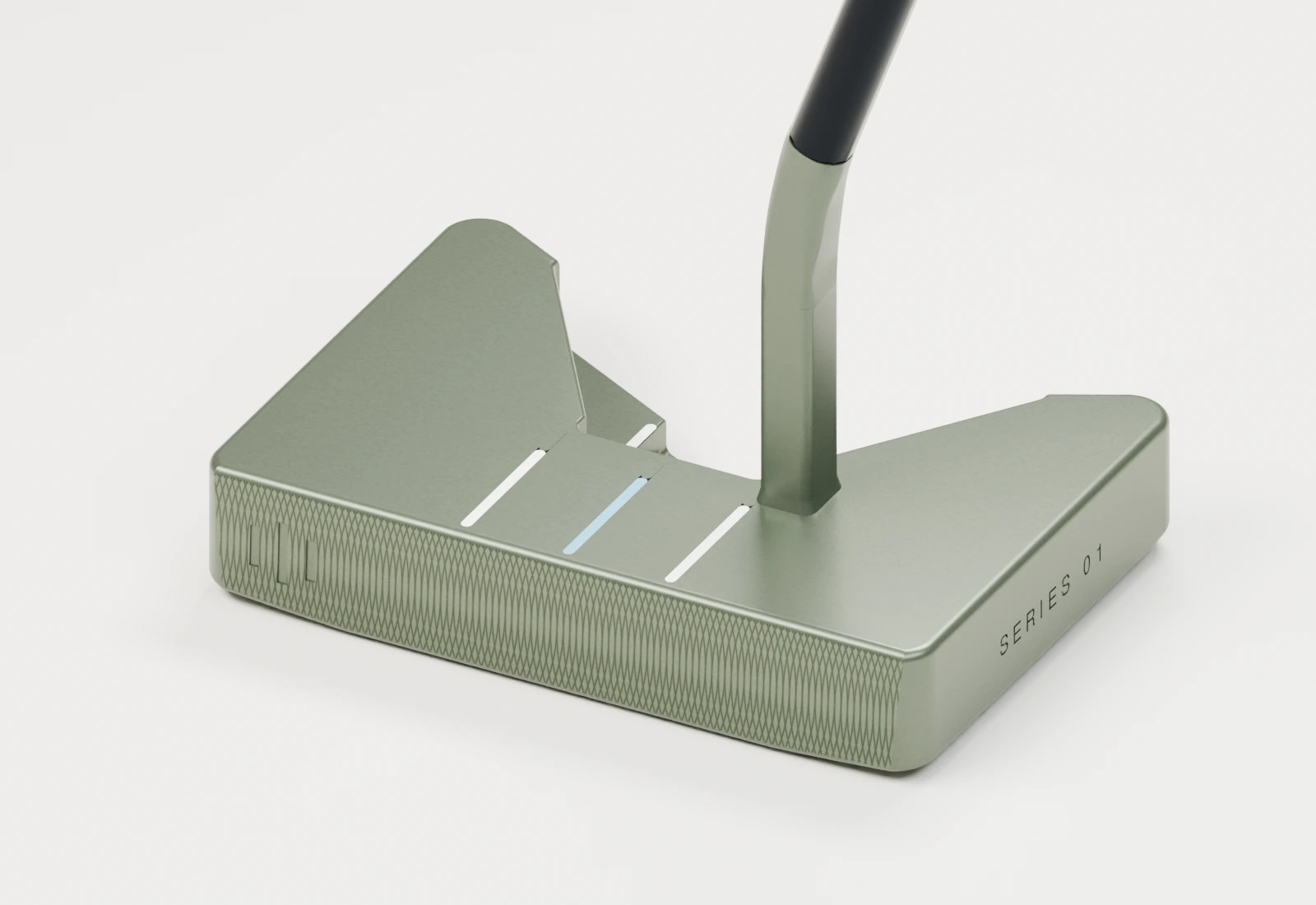
Face-balanced vs toe-hang vs zero-torque putters
A clear comparison of putter balance types, how each is measured, and what face balance, toe hang, and zero torque can predict about a stroke.
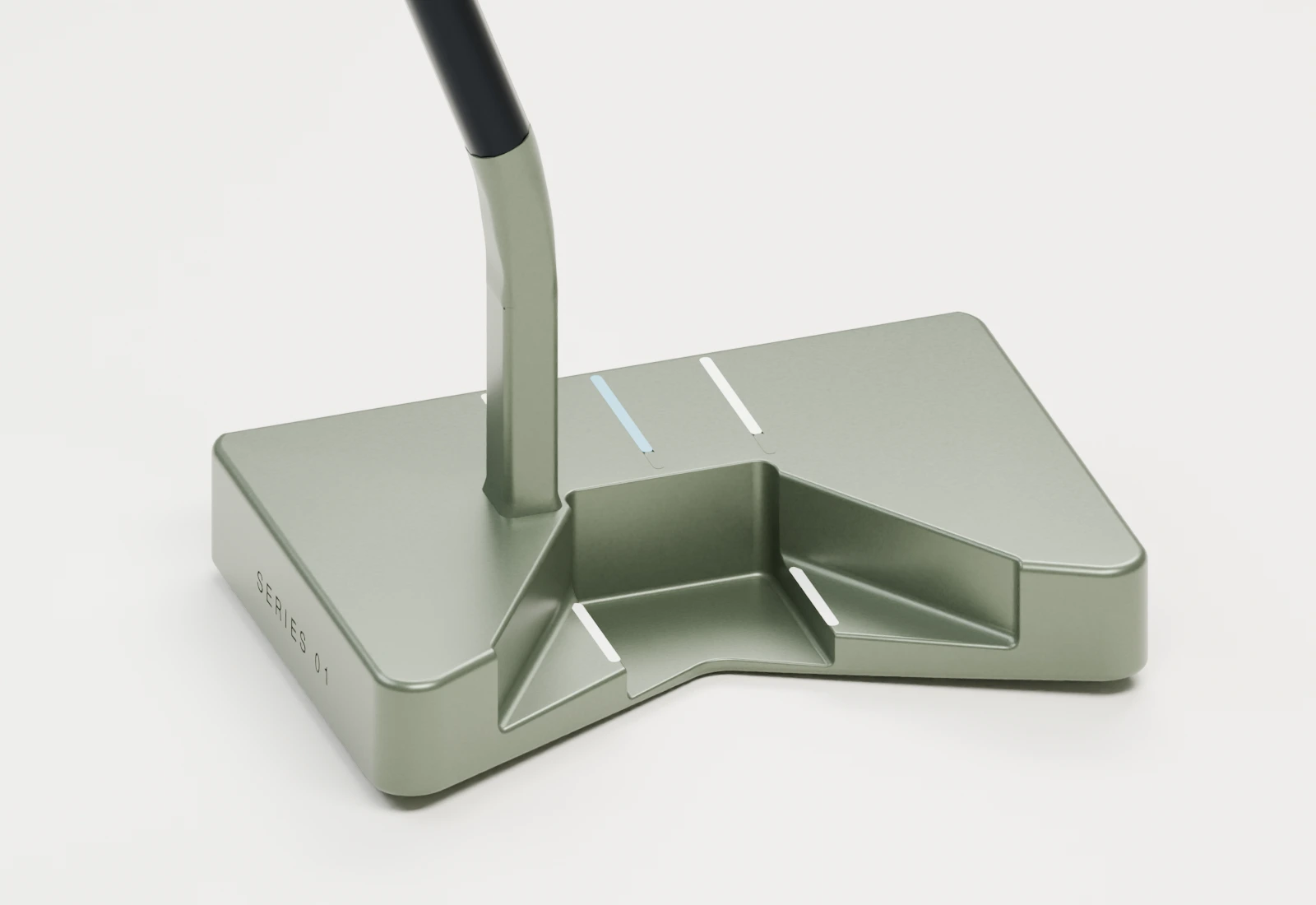
Face balance and toe hang describe how a putter settles when its shaft is supported horizontally. Zero torque usually describes how little gravitational turning moment the assembled club produces around the shaft axis in a playing-angle test.
These labels are often presented as three points on one scale. They come from different test conditions, so the comparison needs more care.
How is a face-balanced putter measured?
Place the shaft horizontally on a narrow support and allow the head to rotate freely. A face-balanced putter settles with the face pointing approximately upward.
In that position, gravity has brought the club’s centre of gravity beneath the support line. The resulting face orientation is the outcome of the assembled club’s mass distribution, shaft position, and support location.
“Face-balanced” is a practical category with normal fixture and reporting tolerances. A head may sit a few degrees away from level and still receive the label.
The horizontal test tells you where the face prefers to settle in that test.
How is toe hang measured?
Use the same horizontal-shaft setup. If the toe rotates towards the ground, the putter has toe hang.
The angle is usually described by the face’s resting orientation relative to face-up. More toe hang means the toe settles farther below the heel. Golfers may also hear clock-face labels such as “four o’clock,” though degrees provide a clearer description when the measurement method is consistent.
Hosel style can influence toe hang because it changes the relationship between the shaft axis and centre of gravity. A mallet can have toe hang, and a blade can sit close to face-balanced.
The assembled mass and geometry produce the balance result.
How is zero torque measured?
The term usually refers to a putter supported near its playing lie angle, with the head free to rotate around the shaft axis. A well-balanced assembly shows very little tendency for the face to seek a new orientation under gravity.
The engineering quantity is residual moment around that axis. A visual test can demonstrate the tendency, while a controlled fixture can measure its size. Shaft, hosel, grip, adhesive, and final head weights all contribute.
Golf marketing uses “zero torque” loosely. Some brands use it for lie-angle balance, some for torque-balanced designs, and some for a face that appears stable in a demonstration. The exact axis, club orientation, and tolerance should accompany a precise claim.
It also describes a limited condition. Player input and off-centre impact can still create torque during a stroke. What zero torque changes explores those boundaries.
The test needs an axis, an orientation, and a tolerance.
Are the three categories mutually exclusive?
Face balance and toe hang share one horizontal test and sit on the same scale. Face-up represents little or no toe hang, while increasing toe-down orientation represents more toe hang.
Zero torque comes from a different support condition. A putter designed for very low torque around the shaft axis at its playing lie may display a particular face orientation when balanced horizontally. Its residual moment in the playing-angle test defines its zero-torque performance.
This is why a simple face-balanced versus zero-torque comparison can mislead. One label reports a resting position. The other aims to report a small turning moment around a specified axis.
Different tests can describe the same club.
What can balance predict about a stroke?
Balance can indicate the passive rotational tendency a player may feel. A toe-hang putter has a stronger gravity-driven preference to rotate towards its horizontal resting position. A face-balanced putter has a different preference. A low-torque design aims to reduce that tendency around the shaft during the playing-angle test.
Those differences may change how much rotational feedback reaches the hands. Some players respond by releasing the face more. Others resist the motion or apply their own torque through the grip.
The label cannot predict that response. It gives the fitter a mechanical property to test against the player’s movement.
Balance describes the tool’s tendency. The golfer completes the system.
Can toe hang tell you how much arc a stroke needs?
No balance category prescribes one stroke shape. The putter naturally travels on an inclined plane because the shaft is held at a lie angle, so even a quiet stroke often appears to move inside the target line on either side of impact.
Body geometry, posture, hand path, shaft lean, face control, and camera perspective all affect the observed arc. A golfer with visible face rotation may perform well with a face-balanced head. Another may deliver a toe-hang model consistently.
The familiar rule matching more toe hang to more arc can serve as a starting hypothesis. It still needs testing with face angle, impact location, and start direction.
A stroke pattern deserves measurement before it receives a putter category.
Does zero torque keep the face square?
A low-torque balance condition reduces one source of passive face rotation. It cannot aim the putter, organise the player’s hands, or return the face square to the intended start line.
The player can rotate the shaft, alter the path, change grip pressure, or strike the ball away from the centre. Each action can change impact. Green reading and pace remain separate skills as well.
The value of the design is a quieter rotational tendency for golfers who respond well to it. Torque in a putter explains the other moments that remain in the system.
Reduced intervention from the club still leaves the stroke to the player.
How should you choose between them?
Begin with measured outcomes. Check face angle, start direction, impact pattern, and pace across several putters without forcing a new stroke for each head.
Include perception. Aim the face before receiving feedback. Notice whether the head feels stable during changes of direction and whether that sensation helps the motion repeat.
A start-line gate drill can provide a simple first screen. A fitting with impact and face data adds the detail needed to separate balance from aim or contact.
For a concrete design example, STILL’s approach to shaft-axis balance shows where the shaft enters our mallet and how that relates to the centre of gravity. Those design targets are separate from the physical fitting and balance tests discussed here.
The best category is the one that produces a repeatable result in the player’s normal setup.