What is MOI in a putter?
Putter MOI measures resistance to rotation around a stated axis. Learn how it affects off-centre strikes, how it is measured, and why context matters.
MOI, or moment of inertia, measures how strongly a putter head resists angular acceleration around a specific axis. In practical terms, more MOI can reduce head rotation when impact occurs away from the centre.
The axis matters. So do the units, head mass, and test method. A single MOI number without that context says very little.
How is putter MOI calculated?
Moment of inertia depends on how much mass an object has and how far that mass sits from the chosen axis. As the moment-of-inertia definition in OpenStax University Physics shows, mass farther from the axis contributes disproportionately because distance is squared in the calculation.
That is why perimeter weighting can raise MOI. Moving a small amount of mass towards the heel and toe may change the result more than leaving the same mass near the centre.
MOI has units of mass multiplied by distance squared. Golf equipment may report values as g cm^2, while engineering work may use kg m^2. Values can only be compared after the units and axes agree.
Mass distribution creates the resistance.
Which axis does a putter MOI number use?
The common performance discussion concerns rotation of the face during an off-centre strike. That is usually associated with an axis running vertically through, or near, the head’s centre of gravity when the putter is in its playing orientation.
Other axes are possible. A head also has MOI for pitching around a heel-to-toe axis and for rotation around a front-to-back axis. The assembled club has further inertia properties around the shaft axis and around the player’s hands.
The same head therefore has many valid MOI values. Each describes resistance to rotation around one defined line.
An axis belongs beside the number.
What happens on an off-centre strike?
During impact, the ball applies force to the face. When that line of force misses the head’s centre of gravity, it creates torque.
The farther the strike sits from the relevant centre line, the larger the lever arm becomes. For the same force, a strike 12 millimetres from that line creates twice the torque of one 6 millimetres away.
Higher MOI reduces the resulting angular acceleration. The face may rotate less during the collision, which can help preserve start direction and make speed loss across the face more consistent.
Impact location still changes the collision, and face construction, centre-of-gravity position, total mass, friction, and ball properties all influence the result.
Stability reduces the rotational penalty from the strike.
Why do mallets often have higher MOI?
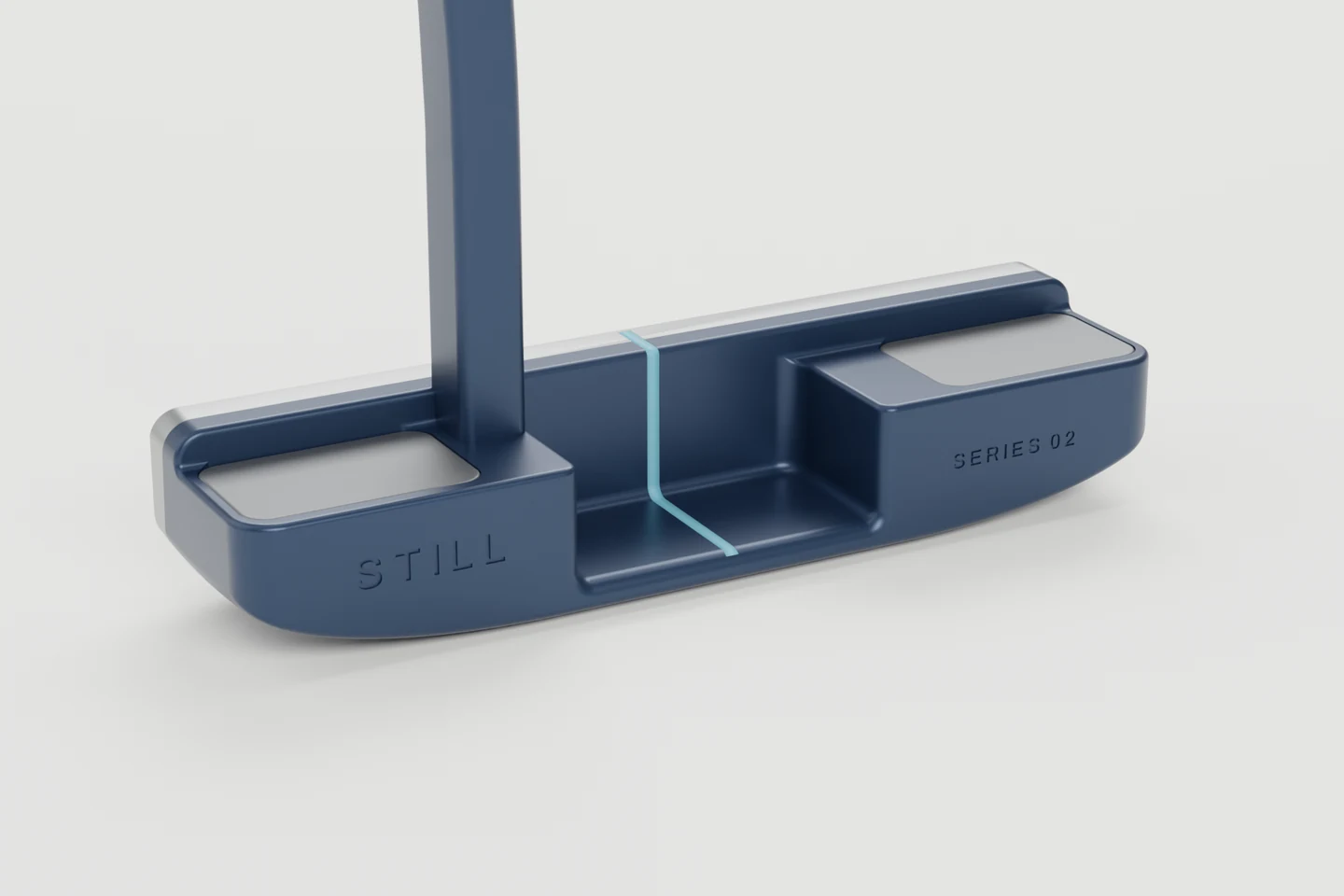
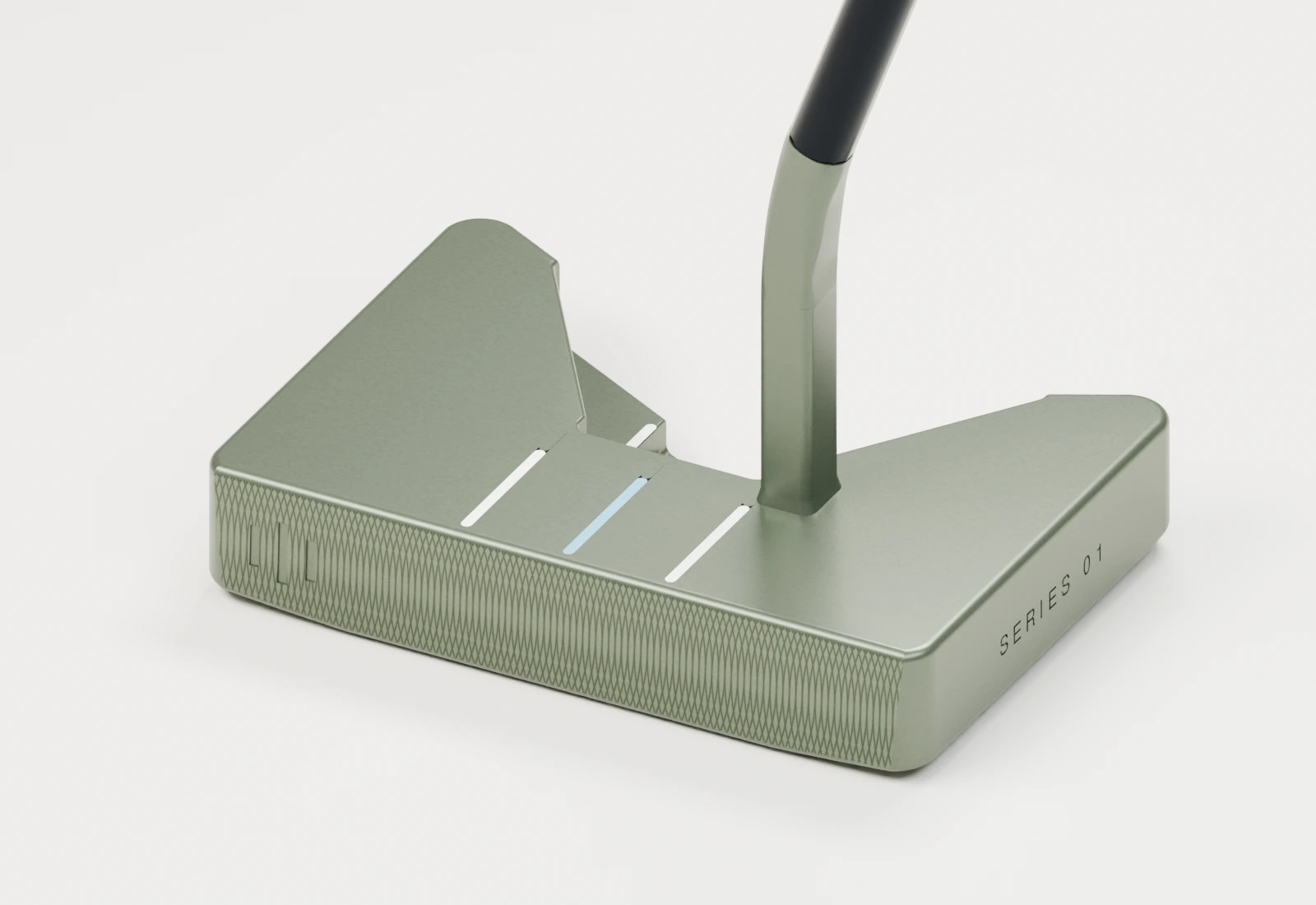
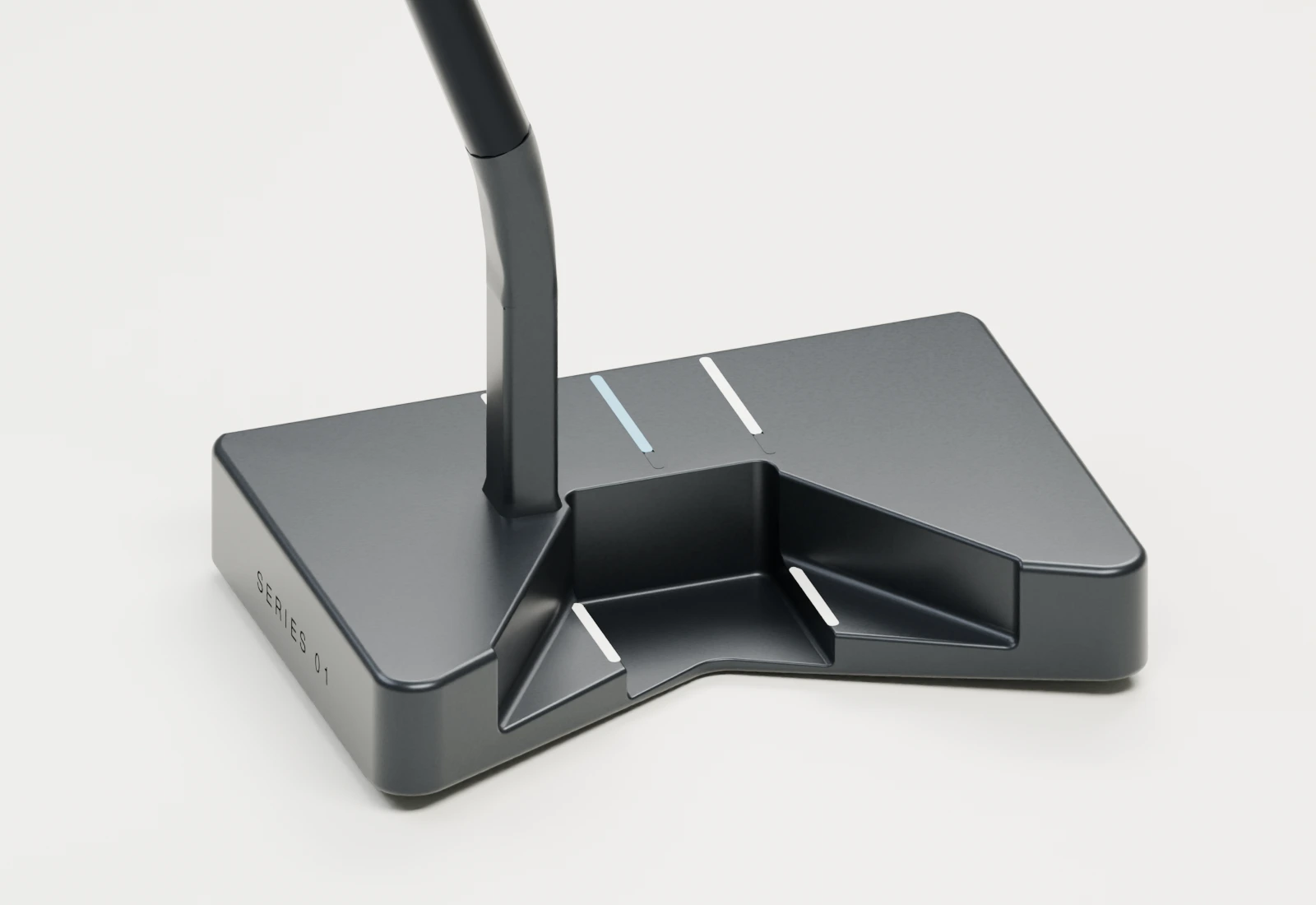
Mallet geometry gives designers more space in which to position mass away from the centre. Wings, rear structures, and heel-to-toe weights can increase the squared distance term that drives MOI.
Blades usually occupy less area, so their mass tends to sit closer to the central axis. Material selection and dense sole weights can still produce meaningful stability within a compact shape.
Head category alone leaves the comparison unresolved. A compact head with efficient weighting may exceed a larger head whose mass remains central. Total mass also changes the number.
The fuller comparison in blade versus mallet putters includes alignment, footprint, and feel alongside stability.
The STILL technology overview shows how our mallet separates its body and weights to position mass. It provides a design example; the published CAD targets still need validation on the physical assembly.
Shape creates design room. The mass map decides how that room is used.
What trade-offs come with higher MOI?
Moving mass outward can enlarge the head, alter the centre of gravity, and change sound or vibration. Adding mass to raise MOI can also change overall head weight and the player’s sense of pace.
Designers can use low-density structures with denser perimeter weights to manage those effects. That adds parts, interfaces, and manufacturing requirements. A simple one-piece head offers a different set of constraints.
MOI also says little about alignment preference. Some golfers aim a broad mallet more consistently. Others see the target line more clearly with a compact blade. Visual response belongs in the fitting alongside impact data.
One metric rarely chooses the whole putter.
Why does a single MOI number need context?
First, find the axis and units. Then check whether the figure describes the bare head or the complete club, and whether accessories or movable weights were installed.
Next, compare like with like. A value around the head’s centre of gravity cannot be placed directly beside a value around the shaft axis. Even values on similar axes may use different reference positions or calculation methods.
Marketing often uses “high MOI” as a broad synonym for forgiveness. The engineering term is narrower. It quantifies rotational inertia around an axis and does not directly measure launch, roll, feel, aim, or distance control.
The number becomes useful when the measurement condition travels with it.
How should MOI influence a fitting?
A golfer who often strikes the ball towards the heel or toe may benefit from more rotational stability. Face impact tape, spray, or launch measurement can reveal that pattern.
Then test the whole outcome. Look at start direction and pace across centred and off-centre strikes. Include aim, head shape, sound, and the ability to return the face consistently.
MOI can make a putter more tolerant. Fit decides whether that tolerance helps the player in front of it.